


Parcel Locker Vendor Selection Guide
Buying guidance for apartment owners condominium boards and property managers
By Package Nexus
The best parcel locker vendor for your property is the one that can demonstrate secure deliveries, convenient pickup, sufficient capacity, and fewer tasks for your onsite team. Evaluate the complete delivery process, including what happens when a courier makes a mistake or a resident leaves a transaction unfinished. Then compare the installed cost, recurring fees, support responsibilities, and room or locker configuration that your building actually needs.
Package Nexus brings these decisions together through patented On-Auto-Pilot Smart Parcel Lockers, the Standalone Package Room, and the Integrated Package Room. These options help properties move routine package handling into a controlled, self-service process while choosing the right storage for ordinary parcels, bulky items, and temperature-sensitive deliveries.
Start with the work you want to remove
A successful package management investment gives your staff time back. Residents can retrieve deliveries without a scheduled handoff, couriers have a clear delivery destination, and managers spend less time answering questions about package status. The strongest business case measures these changes alongside physical security and resident convenience.
Before requesting proposals, list the tasks your team performs today: receiving packages, recording deliveries, contacting residents, searching shelves, arranging access, correcting delivery records, and handling uncollected items. Measure the time spent on them during an ordinary week and a busy period. These observations become your vendor requirements and your baseline for evaluating results.
When selecting smart parcel lockers for apartments and condos, ask every vendor a direct question: “Which of these tasks will your system complete automatically, and which will still require our staff?” Request a demonstration of the answer.
Choose the right storage model
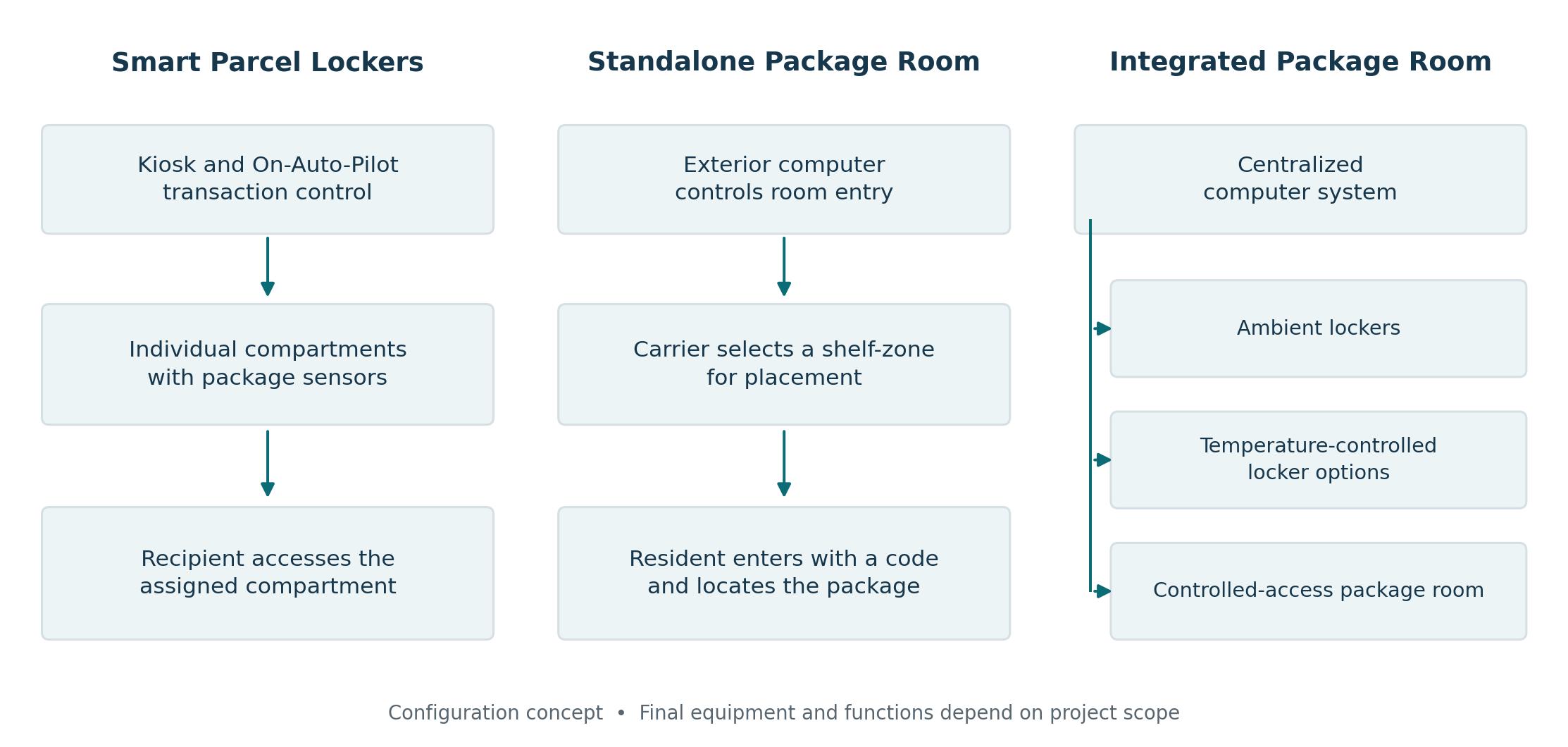
Smart Parcel Lockers for individual compartment security
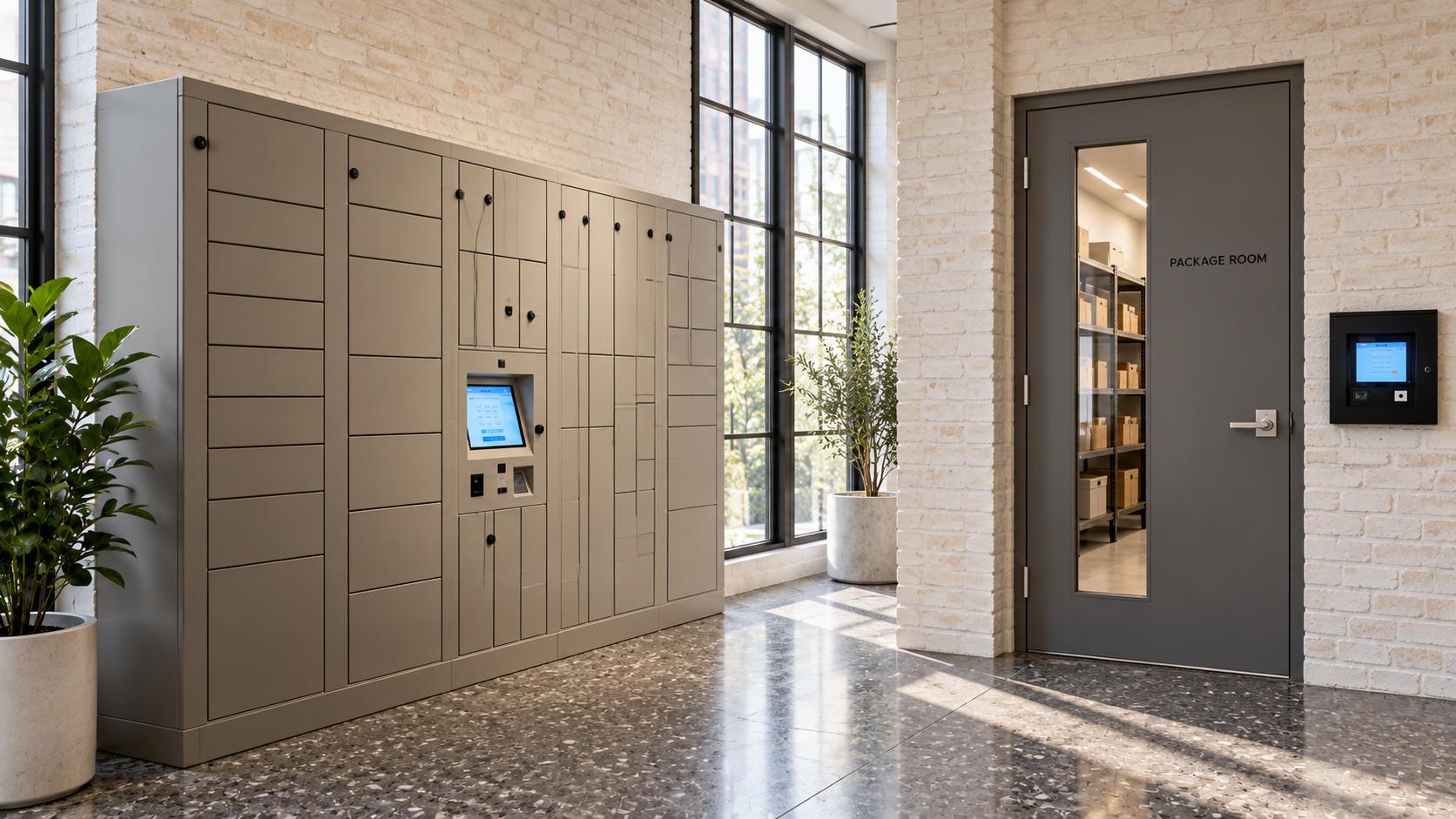
Package Nexus patented On-Auto-Pilot Smart Parcel Lockers place deliveries in electronically controlled compartments. The combination of sensors and automated workflows verifies package activity and addresses common delivery and pickup mistakes. Residents use their pickup credentials to access the relevant compartment, reducing dependence on a staffed package desk.
Choose indoor parcel lockers when your property has a suitable lobby, mailroom, corridor, or other protected space. Consider outdoor parcel lockers when an exterior location offers better access or preserves valuable interior space. Both choices require an installation plan that fits the site and the equipment being quoted.
Standalone Package Room for flexible shelf storage
The Package Nexus Standalone Package Room turns a suitable room into an organized, access-controlled delivery destination. A computer outside the door controls entry for delivery carriers and residents. During delivery, the carrier chooses a shelf-zone, giving the package a defined place within the room. The resident receives a unique pickup code and can locate the delivery in the selected zone.
The exterior computer includes an embedded camera that captures a photo of the person entering. Optional interior cameras and large monitors can extend visibility inside the room. This solution is particularly useful when an existing room is available, bulky packages are common, or the property needs an alternative to purchasing a full locker bank. The final cost depends on the room, shelving, door hardware, power, network, and selected options.
Integrated Package Room for a broader delivery mix
The Package Nexus Integrated Package Room combines Smart Package Room access with ambient smart lockers and selected refrigerated or other temperature-controlled lockers, all managed through a centralized computer system. Properties can plan secure compartments for routine deliveries, appropriate temperature zones for eligible items, and room space for bulky packages or overflow.
This arrangement gives a community a broader package management solution under one coordinated system. Confirm the storage types, room access hardware, notifications, and management functions included in the proposal. Each storage area must have enough capacity for its intended use; an overflow room does not make the installation unlimited.
| Property Requirement | Configuration to Evaluate | Main Reason |
|---|---|---|
| Individual access to ordinary parcels | Smart Parcel Lockers | Separate compartments and sensor-supported transactions |
| Suitable existing room and a constrained locker budget | Standalone Package Room | Controlled entry and organized shelf-zones |
| Regular oversized deliveries | Standalone or Integrated Package Room | Flexible space for items that exceed compartment dimensions |
| Ordinary parcels plus groceries and bulky items | Integrated Package Room | Coordinate compartments, selected temperature zones, and room storage |
| Limited interior wall space | Outdoor lockers or a suitable package room | Match available space to the delivery process |
Room access and compartment access provide different forms of security. A locker separates one recipient’s package from other deliveries. In a shared package room, an authorized person may be able to reach other parcels. Zone labels, entry records, camera coverage, and resident procedures therefore matter alongside the door lock.
Make automation a central selection criterion
Automated notification is useful, but buyers should also examine how the system verifies what actually happened. A delivery screen can say that a transaction is complete while the physical package remains in an unexpected state. Those mismatches create calls, searches, and interruptions for the property team.
Patented On-Auto-Pilot technology is central to the Package Nexus approach. Its sensors and transaction logic are designed to verify deposits and withdrawals, address unfinished sessions, and correct supported user errors as they occur. When the system resolves a covered transaction automatically, that issue no longer needs to become a site manager’s troubleshooting task.
The practical benefit is staff independence from recurring, preventable package issues. Managers can spend more time on leasing, resident service, maintenance coordination, and other property responsibilities. A system that leaves routine exceptions for staff to investigate can retain a substantial operational burden even after self-service pickup has been introduced.
Ask to see the automatic resolution of each relevant scenario. Distinguish an issue the system resolves, an issue remote support resolves, and an issue that requires someone onsite. That distinction is more useful than a general promise of automation or a long list of support channels.
Demonstrate the situations that generate support requests
Use test parcels and authorized test accounts. Record the final package status, the notification sent, and the person who must act. Package Nexus’s published descriptions support the scenarios below as evaluation priorities; confirm the exact behavior of the proposed configuration during the demonstration.
| Demonstration Scenario | Evidence to Request |
|---|---|
| Courier places a package but leaves the session unfinished | Correct occupancy and delivery status after the timeout |
| Courier opens a compartment but deposits nothing | No false completed-delivery record or misleading pickup notification |
| Resident opens a compartment but leaves the parcel inside | Status and pickup access remain consistent with the parcel still being present |
| Resident removes the parcel without finishing the screen flow | Completed pickup is recorded without a manual status correction |
| Small envelope or thin parcel is delivered and collected | Reliable detection for representative small and flat items |
| Door remains open | Clear system response, notification, and responsibility for physically securing the door |
| Carrier chooses a room zone | The selected zone is recorded and understandable during pickup |
| A genuine equipment fault occurs | A defined escalation path and authorized recovery procedure |
The goal is to eliminate staff involvement in the routine errors the system can resolve. Hardware faults, damaged doors, building access problems, and unusual delivery disputes still need a service process. Ask the vendor to identify those responsibilities before purchase. Room shelf-zones should also be demonstrated separately from locker sensors; an entry camera does not establish sensor verification of every parcel on an open shelf.
Compare hardware and security as a complete system
Package Nexus publishes specifications that include industrial-grade computer hardware, a large touchscreen, dedicated scanning equipment, and sensor-based package monitoring. These are useful selection criteria because the kiosk, locker enclosure, locks, and software must work together through repeated daily use.
The table below summarizes published Package Nexus features to discuss during procurement. Use the final proposal and equipment schedule to establish exactly what is included in your installation.
| Published Feature | Procurement Detail to Confirm |
|---|---|
| Heavy-duty 12-gauge steel and galvanized construction described in the comparison material | Cabinet and door materials, coating, anchoring, and the construction of the quoted model |
| Industrial-grade fanless PC with solid-state storage | Serviceability, replacement process, and supported operating environment |
| Industrial touchscreen | Indoor or outdoor screen model, visibility, mounting position, and weather suitability |
| Dedicated Honeywell 1D and 2D scanner; 3320G identified in comparison material | Supplied scanner model and successful reading of representative carrier labels |
| Infrared package sensors | Detection of large, small, and flat test items in the selected compartments |
| Separate physical Braille keypad | Included accessibility features and usability of the full installed route |
| Embedded cameras and electronic locks | Camera locations, recording scope, authorized access, and retention settings |
| Refrigerated, freezer, and heated locker options | Selected compartment type, operating range, monitoring, and maintenance requirements |
| Cloud-connected management and offline capability described on the technology page | Which delivery and pickup functions continue during an outage and how records synchronize |
Look beyond a strong cabinet
Physical protection depends on the complete assembly: doors, hinges, locks, mounting, installation location, and the surrounding environment. Ask for the exact product specifications and applicable test documentation. For exterior installations, confirm environmental limits, drainage, exposure to direct sun, corrosion protection, and the conditions covered by warranty.
Review digital access with the same care. Determine who can view resident data, change permissions, open compartments remotely, and export activity records. Request evidence of security maintenance, encryption, access logging, and the process for removing former residents or employees. Software platform names and compiled code do not, by themselves, establish cybersecurity.
Make access practical for residents and carriers
A convenient system needs a usable route from the delivery entrance to the storage area. Review door openings, delivery cart access, clear circulation, lighting, kiosk reach, and the location of accessible compartments. Assess the installed design with the project’s accessibility professionals; one keypad feature cannot establish compliance for an entire site.
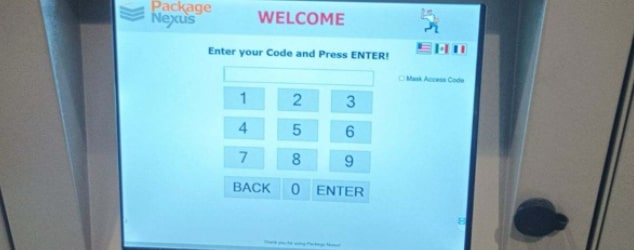
Request demonstrations with the carriers, label types, recipient records, and pickup methods your property expects to use. Confirm how people without a smartphone receive and use their pickup credentials. For building entry and delivery procedures, review carrier delivery guidance with the property team before launch.
Size the system around delivery and pickup patterns
Unit count provides context, but actual package arrivals and collection times determine how quickly storage fills. Ask vendors to examine daily deliveries, peak periods, the share of small and oversized parcels, and how long residents usually wait before pickup. A community with quick collection can use the same compartments more frequently than one where parcels remain for several days.
For an initial planning estimate, multiply daily packages by average days in storage. For example, 60 packages per day held for 1.5 days imply approximately 90 packages awaiting collection. Adding an illustrative 25 percent planning allowance gives about 113 package positions after rounding up. This is a planning example, not a recommended compartment count or a Package Nexus capacity promise.
A vendor must still convert that estimate into a size mix, account for peak-day variation, and define overflow. One package position is not always one compartment, particularly when authorized consolidation or room storage is used. Examine usable compartment dimensions and door openings against real sample parcels.
Use oversized package planning to decide which deliveries belong in large compartments and which need a room. Shelves, floor zones, and clear walkways should be designed together. The carrier and resident must be able to place and retrieve large items without blocking everyday pickups.
Include temperature needs in the initial design
If groceries or other temperature-sensitive deliveries form a meaningful part of your package mix, evaluate temperature-controlled smart lockers at the same time as ambient capacity. Package Nexus offers refrigerated, freezer, and heated options that can be included in the broader package management configuration.
Specify the intended items, required holding conditions, pickup window, monitoring, and responsibility for uncollected deliveries. Confirm the actual temperature performance of the proposed model and its suitability for the items being accepted. A room with ordinary shelves does not provide refrigerated storage, and temperature control should not be assumed from an outdoor enclosure or a general product label.
Evaluate integration and continuity
Resident records must remain accurate as people move or change contact details. Ask how the property management system exchanges data with the locker or room platform, which fields are required, how often updates occur, and who handles failed imports. The proposal should identify the integration actually being delivered.
Test a new resident, an updated contact record, a deactivated account, and a missing recipient. Confirm the effect on delivery selection, pickup, and notifications, including how incorrect contact details are corrected.
Demonstrate a network interruption and identify usable credentials, functions that pause, record storage, and synchronization after reconnection. Evaluate power loss separately, including backup power options and authorized emergency access.
Compare total cost and retained staff time
A useful quotation separates equipment, installation, site preparation, software, notifications, connectivity, maintenance, and support. Include package-room shelving, door hardware, cabling, and camera or monitor options. Ask for charges associated with expansion, integration changes, relocation, and replacement hardware.
Compare proposals over the same operating period. A five-year cost comparison can include the initial installed price plus five years of recurring charges and expected maintenance, together with the staff work each option retains. Record renewal terms, price increases, cancellation provisions, data export, and what functions remain available at the end of the agreement.
An illustrative labor calculation
Suppose a property receives 60 packages each day and currently spends four staff minutes per package across intake, notification, search, and handoff. If the new workflow averages one staff minute per package when residual work is spread across all deliveries, the following example applies. These are assumptions for demonstrating the calculation, not measured Package Nexus results or industry averages.
| Calculation | Illustrative Result |
|---|---|
| Current daily labor: 60 packages × 4 minutes | 240 minutes or 4 hours |
| Residual daily labor: 60 packages × 1 minute | 60 minutes or 1 hour |
| Time released each day | 3 hours |
| Annual time released at 365 receiving days | 1,095 hours |
| Value of released capacity at a $30 loaded hourly cost | $32,850 per year |
Replace every input with your property’s measured conditions. Time released is productive staff capacity; it becomes a cash saving only when overtime, contracted work, payroll, or another actual expense falls. Any payback calculation must also deduct recurring system costs and use the complete installed investment. Explore how smart lockers reduce property management costs when building the proposal for ownership.
Use a weighted vendor scorecard
Score each vendor against the same requirements after the demonstration and written proposal. The weights below are a suggested starting point for a multifamily property that prioritizes staff productivity. Adjust them before evaluating suppliers, so the result reflects the property’s priorities.
| Evaluation Category | Weight | Evidence to Score |
|---|---|---|
| Automation and remaining staff work | 25% | Exception demonstrations and a clear division of responsibilities |
| Capacity and storage fit | 20% | Package analysis, compartment mix, room plan, and overflow approach |
| Physical security and digital controls | 15% | Product specifications, access controls, logs, and security evidence |
| Resident and carrier usability | 10% | Representative delivery and pickup tests, including accessibility |
| Support and service continuity | 10% | Service scope, response commitments, recovery process, and parts coverage |
| Total cost of ownership | 15% | Comparable installed and recurring costs over the same period |
| Integration and future expansion | 5% | Confirmed data workflow and a priced expansion path |
| Total | 100% | Complete before selecting a vendor |
Use a 0-to-5 score: 0 means the requirement is not met or evidence is absent; 3 means it is adequately met and documented; 5 means it is strongly met and demonstrated under the agreed conditions. Multiply each score by its percentage weight and divide by five, then add the results for a score out of 100.
Treat essential requirements separately. A critical accessibility issue, an unsuitable installation location, or an unworkable delivery route should be resolved before a high overall score can justify selection. Request references from properties with a similar package mix, staffing model, and environment.
Confirm support and implementation before signing
Ask who helps residents, couriers, and property staff, during which hours, and through which channels. Establish how the vendor handles urgent access issues, remote troubleshooting, replacement parts, and onsite repairs. A support line’s availability and a guaranteed repair time are different commitments; both should be clear in the proposal.
Review smart locker support and operations alongside the hardware selection. Package Nexus’s published package-room information lists one year of parts and labor for its Standard Tier plan. Confirm the warranty and service terms that apply to the configuration you purchase, including the scope of any optional coverage.
Before installation, assign responsibility for the following steps:
- Approve a measured layout, equipment delivery route, anchoring details, and utility locations.
- Confirm building-entry access for carriers and the final path to the lockers or room.
- Prepare recipient data, test the integration, and verify resident notification details.
- Define room zones, overflow procedures, collection reminders, and handling of unclaimed parcels.
- Train the property team and provide straightforward instructions for carriers and residents.
- Complete acceptance testing with representative packages, pickup methods, and interruption scenarios.
After launch, review package volume, occupancy, time to pickup, failed notifications, support requests, and onsite minutes spent resolving issues. Track exceptions per 1,000 deliveries so busy and quiet periods can be compared. This creates a practical basis for verifying the value of automation and deciding whether additional capacity is needed.
Why Package Nexus belongs on your shortlist
Package Nexus is a strong choice for properties seeking to reduce recurring package work while retaining flexibility in the physical design. Its patented On-Auto-Pilot approach addresses supported transaction errors at the point where they occur. Industrial-grade kiosk components, configurable locker arrangements, and room options let the property evaluate automation and storage together.
The Standalone Package Room adds structure to a suitable existing space through controlled entry, carrier-selected shelf-zones, individual pickup codes, and entry photo capture. The Integrated Package Room extends the selection to coordinated ambient, refrigerated or other temperature-controlled compartments and flexible room storage. Buyers can choose the configuration that matches their deliveries and budget, then test the resulting workflow.
The same selection method is useful beyond apartments. Corporate mailrooms can examine employee and departmental handoffs; retailers can test order pickup; libraries can evaluate patron pickup and their required library-system integration. Hotels and warehouses should define guest, staff, inventory, and access rules specific to their operations. These are application considerations, not a claim that every feature is included in every installation.
To request a Package Nexus configuration and quote, share your floor plan, photos, unit or user count, daily and peak delivery volume, oversized-item requirements, and available power and connectivity. Ask for a configuration review and an On-Auto-Pilot demonstration using the situations in this guide.
Frequently asked questions
How do I choose a parcel locker vendor?
Begin with your property’s package volume, available space, security requirements, and current staff workload. Compare vendors using the same delivery and pickup demonstrations, written service commitments, and cost period. Select the supplier that can show how the proposed configuration meets your requirements, including its behavior when a transaction does not follow the normal sequence.
What makes Package Nexus different when evaluating vendors?
Package Nexus places patented On-Auto-Pilot technology at the center of its locker offering. Sensors and automated workflows are designed to verify package activity and resolve supported delivery and pickup errors. Its portfolio also includes standalone room storage and an integrated locker-and-room approach. Evaluate those benefits through a demonstration and a property-specific proposal.
Can smart lockers eliminate staff troubleshooting?
For supported routine transaction errors, automatic detection and resolution can remove the need for staff to intervene. That is the operational objective of Package Nexus On-Auto-Pilot. Buyers should verify the covered scenarios and distinguish them from equipment repairs, building connectivity problems, physical door closure, and unusual delivery disputes that still need an assigned response.
What is the difference between the Standalone and Integrated Package Rooms?
The Standalone Package Room uses an exterior computer to control access to organized room storage, with carriers selecting shelf-zones and residents receiving pickup codes. The Integrated Package Room combines room access with smart lockers, including selected ambient and temperature-controlled options, under centralized computer management. The appropriate choice depends on package types, available space, and the desired configuration.
Is a package room more affordable than parcel lockers?
A room can be cost-effective when suitable space already exists and only limited modification is needed. Include the cost of shelving, access hardware, electrical work, networking, and optional surveillance. Compare the full installed and ongoing costs with a locker proposal for the same operating requirements. An unsuitable room can require enough construction to change the comparison.
Are package rooms as secure as individual lockers?
They use different access models. A locker limits pickup access to a particular compartment. A room controls entry to a shared storage area, so authorized users may be able to reach other deliveries. Evaluate camera coverage, access records, shelf organization, pickup procedures, and the sensitivity of the packages your property accepts when deciding which model is appropriate.
How many parcel locker compartments does an apartment building need?
There is no single correct ratio for every building. Use delivery volume, package sizes, collection time, and peak-period demand to estimate occupied storage. Then have the vendor propose a compartment mix and overflow plan. A well-used set of smaller compartments and a room for bulky items may serve some properties better than a larger bank of poorly matched sizes.
Can delivery drivers use the system without property staff?
The delivery workflow is intended to let authorized carriers place packages and initiate resident notification directly. Independence also depends on access to the building, a usable recipient list, clear signs, and a functioning kiosk or room-entry system. Test the full route with your expected carriers and confirm how exceptions such as a missing resident are handled.
What should I ask about property management software integration?
Ask which connection method is included, which resident fields are exchanged, how often updates run, and who monitors failures. Verify move-ins, move-outs, changed contact information, and missing records. Put the integration scope, setup cost, recurring charges, and support responsibility in writing so a broad statement of compatibility becomes a defined operating process.
What happens if the internet or power fails?
The answer depends on the installed hardware and configured workflow. Package Nexus describes offline functionality, but the proposal should specify which actions continue, which credentials work, and how records reconcile after reconnection. Evaluate power failure separately, including any backup power option and the authorized access procedure. Test the agreed behavior during commissioning.
Can one system accommodate ordinary packages and refrigerated deliveries?
Package Nexus offers ambient and temperature-controlled locker options, and its Integrated Package Room can combine selected storage types with room access. Specify the actual delivery mix and holding requirements before selecting capacity. Confirm the temperatures, monitoring, maintenance, and pickup procedures for the proposed equipment; ordinary package-room shelves do not replace refrigerated compartments.
Which costs and commitments belong in the final proposal?
Request the installed equipment price, site-preparation responsibilities, recurring software and notification charges, connectivity, maintenance, warranty, training, and service response commitments. Include renewal increases, expansion pricing, data access, and end-of-contract arrangements. A clear proposal helps ownership compare long-term value and gives the property team a workable operating plan from the first delivery.

Package Nexus is the global technology leader and provider of The World's Most Advanced Smart Parcel Lockers for efficient and most simplified package management for multifamily communities, retailers, universities, libraries, corporate offices, groceries, and more. Package Nexus unique and patented technology offers a fix for human errors at the time of package deliveries and pickups. Package Nexus solutions help property, store, and office managers to improve their operations, reduce operating costs, and increase customer satisfaction at the same time. Package Nexus offers its entire suite of solutions globally.
USEFUL LINKS

© 2017-2026 Package Nexus